A guide for visitors to the East
Coming over from the canals? Here's everything we wish someone had told us.
Written by Simon Judge · last updated December 2025 · first published on goba.org.uk
Before you set off
Our rivers are wider, deeper and emptier than the canals you're used to — parts of the Ely Ouse run to four metres deep, and help can be a long way off. None of this kit is exotic, but all of it has earned its place aboard:
- An anchor with chain and warp — if the engine stops out here, this is what stops you.
- A lifebuoy or heaving line, and a lifejacket if you boat alone.
- Decent mooring lines with spares, including springs — you'll raft up more often than you think.
- A mud anchor for the lovely remote stops where there's nothing to tie to.
- Proper navigation lights if you'll cruise at night — a tunnel light won't do, and night cruising isn't allowed on the Middle Level at all.
- An Abloy key — unlocks EA water points, Elsan points and the control panels on Nene and Ouse locks. Order by phone from the EA or buy at Northampton Marina. It doesn't float; we mention this from experience.
- The special windlass (everyone calls it an Ouse key) for Middle Level slackers — you can pick one up en route.
- A Yale key for the Middle Level's unmanned locks and facilities — buy it at Stanground on your way in.
Licences, without the headache
Since 2021 the Middle Level needs a licence too, so a visiting CRT boater wants one of two routes in:
- Going the long-stay route: a CRT/EA Gold licence covers all CRT and EA waters for the calendar year, or an EA Anglian annual licence runs April to March. Add the Anglian Pass to cover the Middle Level and the Cam above Bottisham Lock — £30 for boats under 5 m, £60 to 10 m, £90 to 15 m, £120 beyond, April to March, from visitanglianwaterways.org.
- Just visiting: the EA does a visitor licence up to three months, and the Middle Level Commissioners sell short-term licences in person at Stanground and Salters Lode — bank card only. The Cam Conservators no longer sell short-term licences, so plan the Cam accordingly.
Whatever you carry, sign up for the EA's river advice for boaters before you come — the strong-stream alerts are the difference between reading about a rising river and being on one. When an alert is on, find a safe mooring and put the kettle on. Never enter a reversed lock: open mitre gates, a raised guillotine and a strong current through the chamber are the river telling you no.
The Nene
Most visitors arrive this way, dropping down the seventeen locks from Northampton. The Oundle Cruising Club keeps an excellent, regularly updated moorings guide, and Friends of the River Nene membership is £12 astonishingly well spent — their short-stay moorings rescue many an evening.
Imray and Pearson both publish current guidebooks (GOBA members get a discount on Imray), and Northampton Marina's website carries the stoppage calendars for the Nene, the Great Ouse and strong-stream alerts — subscribe once and the closures come to you.
The Middle Level
The link between the Nene at Stanground and the Ouse at Salters Lode — a working drainage system first and a navigation second, and all the more interesting for it. Book your Stanground passage at least 24 hours ahead on 07824 600470, buy your Yale key there, and pick up the navigation notes leaflet — the bridge heights in it are not a suggestion.
If you have time, it rewards wandering: Benwick, Ramsey, Chatteris, Holme Fen and Woodwalton Fen are all worth the detour (check your air draught). The old Horseway route via Welches Dam is currently unnavigable. Official moorings are few but the wild ones are good — the north bank between March and Low Corner, Beavills Leam south of Angle Corner, and the Commissioners' growing network of rural moorings.
Two calls worth making: email mlcnavigation@btinternet.com with the subject line NAVIGATION TEXT SERVICE and your mobile number to get closure texts, and ring the Salters Lode lock keeper before you get there — the crossing to Denver is tidal and he holds the timetable in his head.
The Great Ouse — our patch
From Salters Lode you're onto our river: the Ely Ouse up through the Fens, then the Bedford Ouse winding to Bedford itself. Imray and Pearson cover it, our own map shows every GOBA mooring and facility, and membership buys you the run of some of the loveliest free moorings in England.
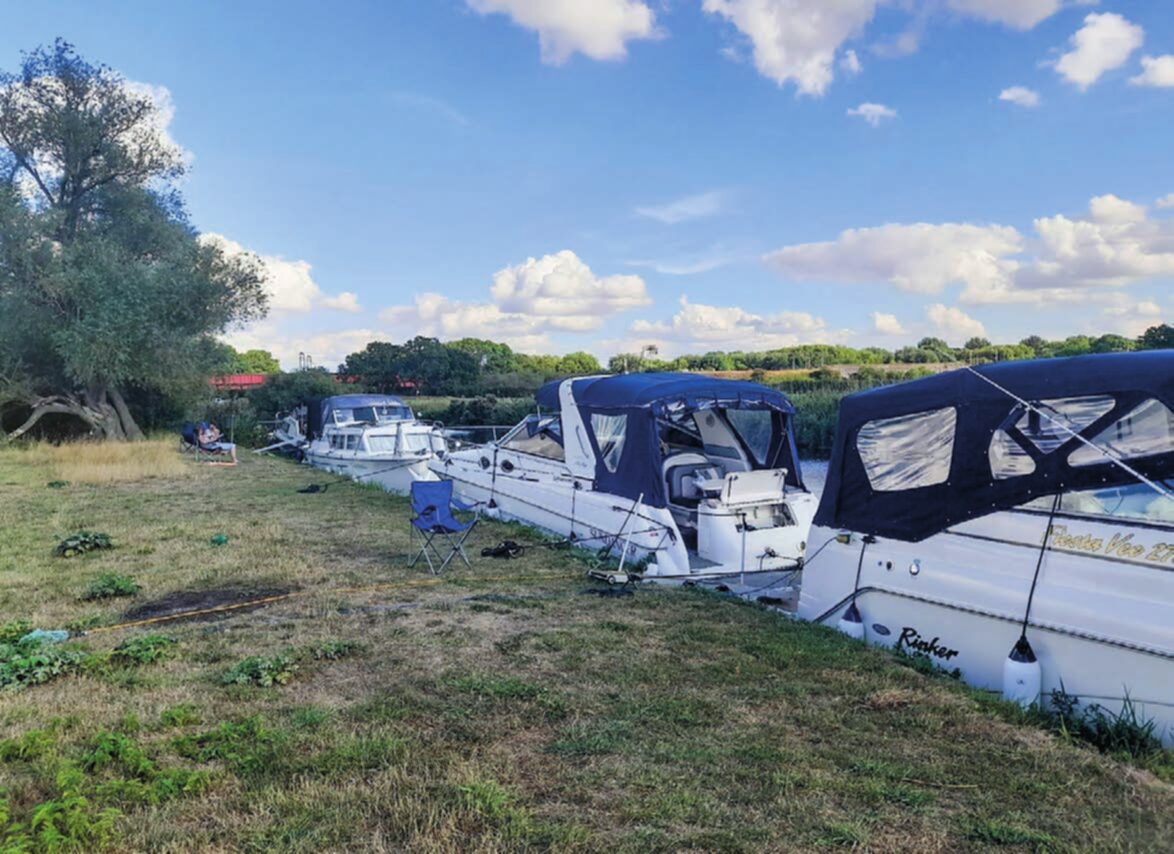
Mooring here comes in two flavours. Organised moorings — EA, town council and GOBA — generally give you 48 hours; read the sign, it varies. Wild mooring is yours at your own judgement: keep a respectful distance from houses, livestock and nesting swans, and be ready to move on with good grace if a landowner asks.
Boats over 60 feet should warn the Salters Lode keeper in advance — on some tides a long boat simply doesn't fit through the window. The Denver crossing has its own guide below; read it before you plan your week.
The Cam
The Anglian Pass covers you above Bottisham Lock. Be honest with yourself about Cambridge: visitor moorings are scarce — two on the left bank by the Fort St George, four on the right below Jesus Green Lock — and the train from Ely or Waterbeach is often the wiser boat. There are proper moorings at Clayhithe, and GOBA moorings at Horningsea and Waterbeach.
Above Baitsbite you share the water with rowers of every standard, and one local rule reverses everything you know: at Grassy Corner, downstream of the Plough, keep to the left bank and downstream boats give way to upstream. Watch the boathouses on the right bank, and don't be shy with the horn — the eights without a cox genuinely can't see you. From October to March a powered boat can book passage along the Backs, which on a quiet winter morning is one of the finest miles in inland boating.
How we do things here
- Moor close, raft up, share. Moorings are scarce and nobody needs six feet of clearance each end.
- Guillotine gates go fully up when you leave — the next boat may be bigger than yours. On the Nene, empty guillotine locks with the gate raised unless water-shortage notices say otherwise; on the Middle Level, do what the sign at the lock says; on the Great Ouse, leave locks as you find convenient.
- Volunteer-run moorings run on goodwill — GOBA's and the Friends of the River Nene's alike. Follow the sign, and the landowner keeps saying yes.
- Learn the dialect: V-doors are mitre gates, slackers are paddles, the pen is the lock chamber, and a staithe is a wharf.
Other ways in and out
- Across the Wash — the tidal passage from Boston to Wisbech is very doable with planning; ring the Dog-in-a-Doublet keeper and read the accounts before you commit.
- The New Bedford River — the dead-straight tidal shortcut from Denver to Earith. Read the tidal advice note and ring the Hermitage or Denver keepers about feasibility and timing before you try it.
- Bedford to Milton Keynes — a waterway that doesn't exist yet, but the campaign is real and worth watching at bmkwaterway.org.
Who to ring
Numbers that earn their place in your phone before you cast off:
- Dog-in-a-Doublet lock (Patrick Mahoney)Mobile keeper — book ahead07789 945971
- Nene inspector, Woodford–Peterborough (Lindon Wise)07920 087741
- Nene inspector, Northampton–Lower Ringstead (Andy Hall)07760 422263
- Nene floodlineDial 1, then quickdial 0321120345 9881188
- Stanground Sluice (Tina)Book transit at least 24 hours ahead07824 600470
- Navigation officer (Kevin Russell)07725 134170
- Salters Lode lockDenver crossing advice and tide windows01366 382292
- Denver Sluice complexUsually an answerphone — leave a message01366 382013
- Denver lockStaffed during active locking only01366 382340
- Hermitage lock, Earith9–6 summer, closed 1–2 for lunch01487 841548
- EA control room0800 807060
- Ouse inspector, Bedford (Andy Hubble)07717 423512
- Ouse inspectors, Ely (Warrick Hammond / Paul Lunan)07867 179919 / 07741 614288
- Ouse floodlineDial 1, then 033212 (Earith–St Ives) or 033211 (St Ives–Bedford)0845 9881188
And remember what this system is: a land drainage scheme first, built by the Dutch, with navigation as a happy extra when the weather behaves. Boat it in that spirit and it will look after you.
Local knowledge, offered in good faith: things change on a living river, and GOBA can't accept liability for the accuracy or completeness of this guide. When it matters, ring the lock keeper — they always know today's answer.